Chain-of-Thought Prompting은 대규모 언어 모델의 추론 능력을 이끌어 낸다
초록
We explore how generating a chain of thought—a series of intermediate reasoning steps—significantly improves the ability of large language models to perform complex reasoning. In particular, we show how such reasoning abilities emerge naturally in sufficiently large language models via a simple method called chain-of-thought prompting, where a few chain of thought demonstrations are provided as exemplars in prompting.
우리는 chain of thought, 즉 일련의 중간 추론 단계를 생성하는 것이 대규모 언어 모델의 복잡한 추론 능력을 얼마나 크게 높이는지 살펴본다. 특히 프롬프트에 몇 개의 chain of thought 시연을 exemplar로 제공하는 chain-of-thought prompting이라는 간단한 방법으로, 충분히 큰 언어 모델에서 이러한 추론 능력이 자연스럽게 나타남을 보인다.
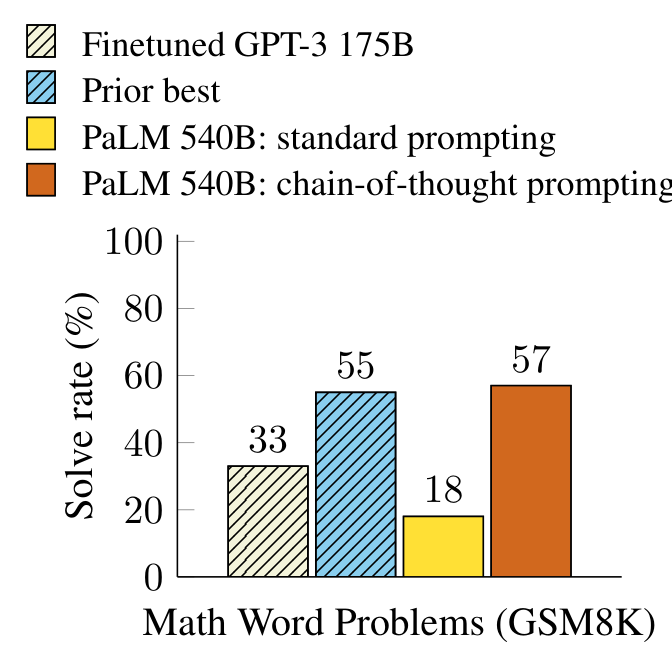
Experiments on three large language models show that chain-of-thought prompting improves performance on a range of arithmetic, commonsense, and symbolic reasoning tasks. The empirical gains can be striking. For instance, prompting a PaLM 540B with just eight chain-of-thought exemplars achieves state-of-the-art accuracy on the GSM8K benchmark of math word problems, surpassing even finetuned GPT-3 with a verifier.
세 가지 대규모 언어 모델로 실험한 결과, chain-of-thought prompting은 산술, 상식, 기호 추론에 걸친 여러 과제에서 성능을 높였다. 향상 폭은 놀라울 정도다. 예를 들어 PaLM 540B에 chain-of-thought exemplar 단 8개를 주어 프롬프트하면 수학 서술형 문제 벤치마크인 GSM8K에서 state-of-the-art 정확도를 달성하며, verifier를 함께 쓰는 finetuned GPT-3마저 넘어선다.
1 서론
The NLP landscape has recently been revolutionized by language models (Peters et al., 2018; Devlin et al., 2019; Brown et al., 2020, inter alia). Scaling up the size of language models has been shown to confer a range of benefits, such as improved performance and sample efficiency. However, scaling up model size alone has not proved sufficient for achieving high performance on challenging tasks such as arithmetic, commonsense, and symbolic reasoning (Rae et al., 2021).
최근 NLP 분야는 언어 모델로 크게 바뀌었다(Peters et al., 2018; Devlin et al., 2019; Brown et al., 2020 등). 언어 모델의 크기를 키우면 성능과 sample efficiency가 좋아지는 등 여러 이점이 있다고 알려졌다. 그러나 모델 크기를 키우는 것만으로는 산술, 상식, 기호 추론처럼 어려운 과제에서 높은 성능을 내기에 충분하지 않았다(Rae et al., 2021).
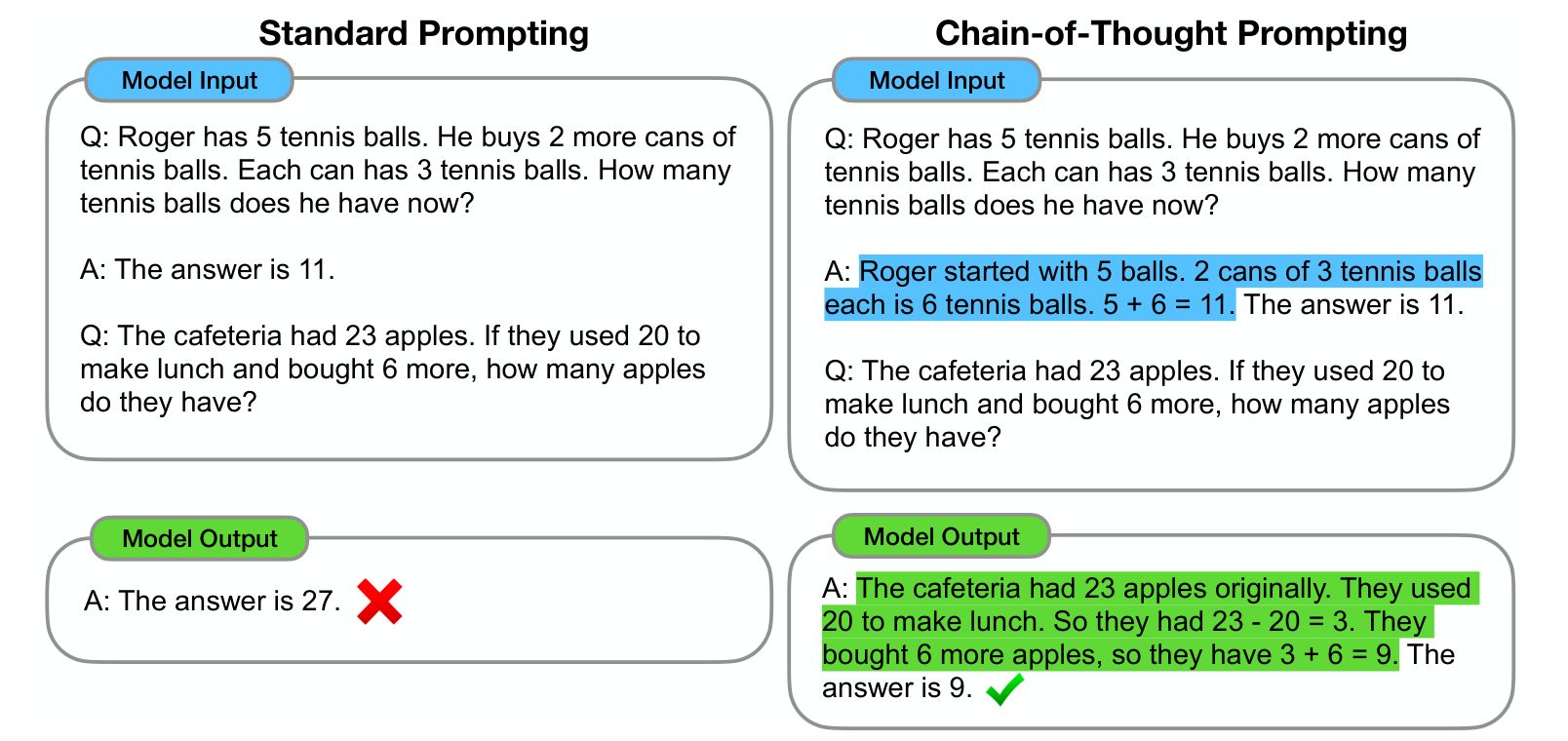
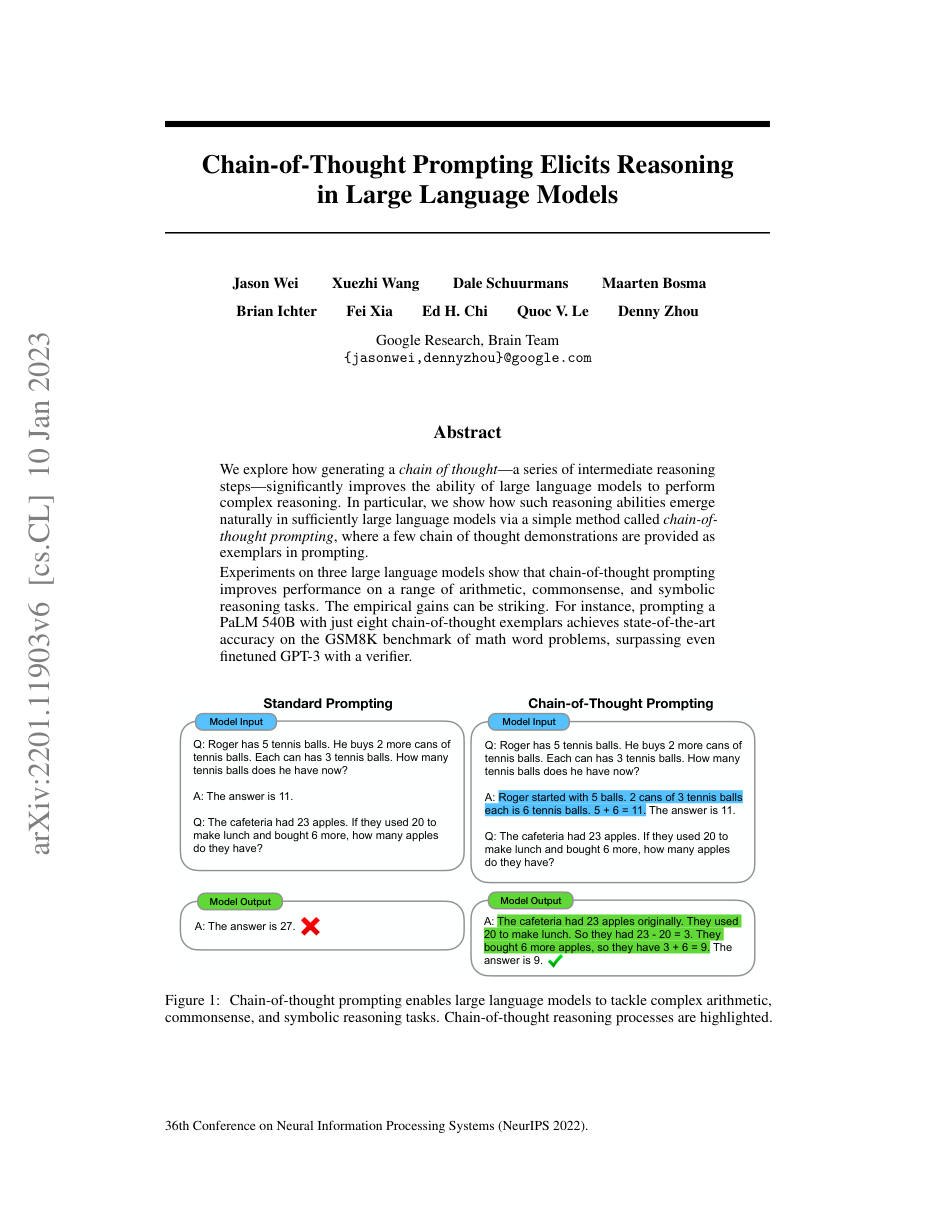
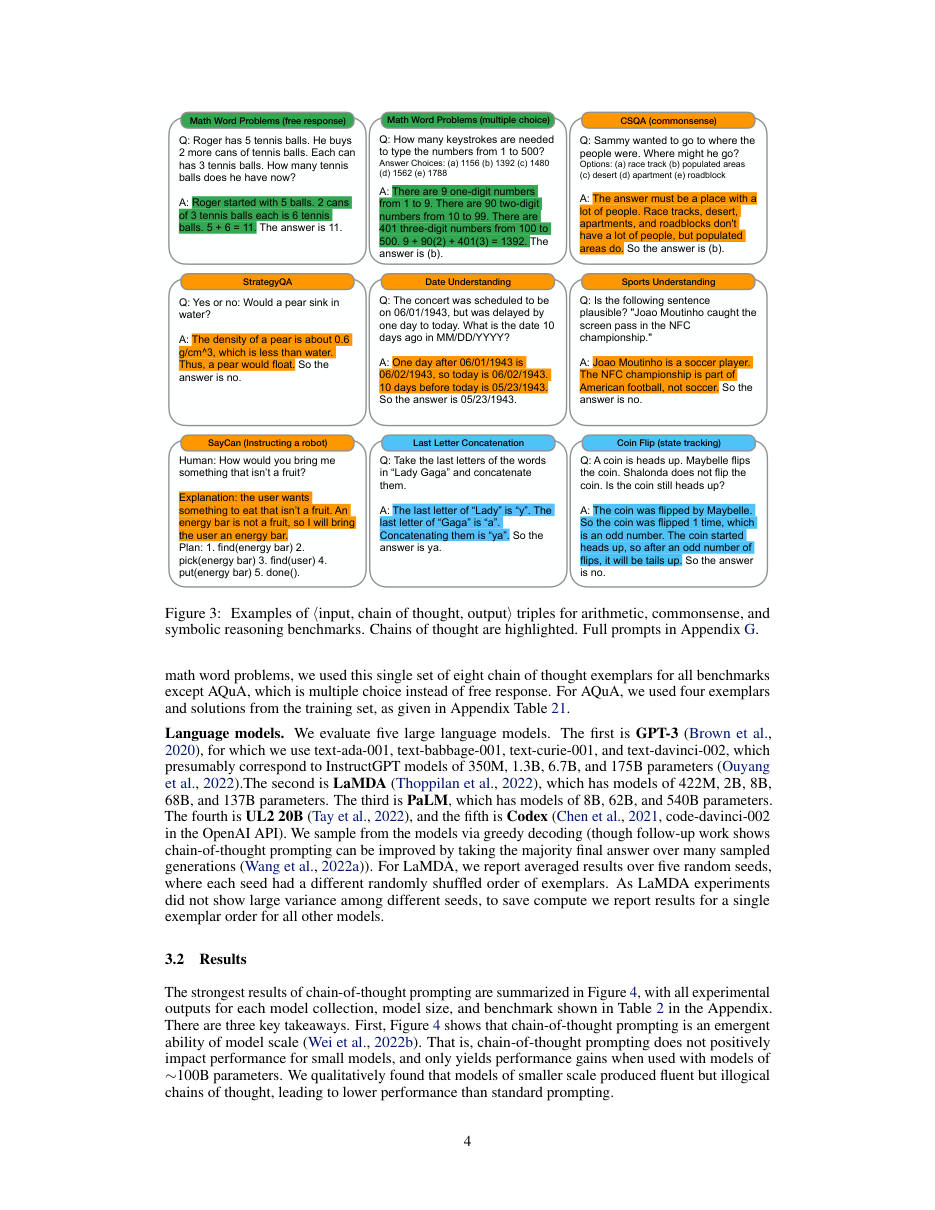
Specifically, we explore the ability of language models to perform few-shot prompting for reasoning tasks, given a prompt that consists of triples: ⟨input, chain of thought, output⟩. A chain of thought is a series of intermediate natural language reasoning steps that lead to the final output, and we refer to this approach as chain-of-thought prompting. An example prompt is shown in .
구체적으로, ⟨입력, chain of thought, 출력⟩ 세 쌍으로 이루어진 프롬프트가 주어졌을 때 언어 모델이 추론 과제에서 few-shot prompting을 수행하는 능력을 살펴본다. chain of thought는 최종 출력에 이르는 일련의 중간 자연어 추론 단계이며, 이 접근법을 chain-of-thought prompting이라 부른다. 예시 프롬프트는 에 있다.
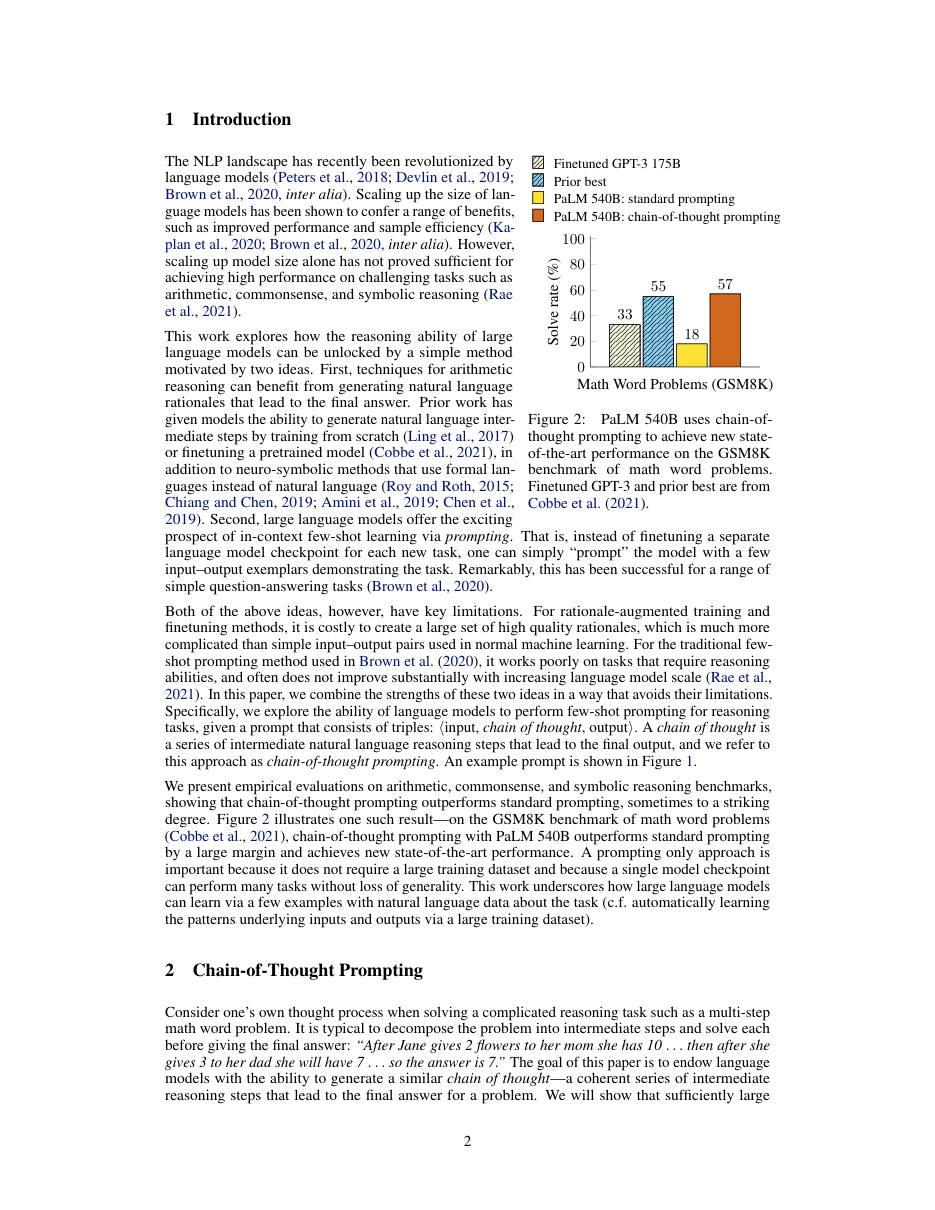
We present empirical evaluations on arithmetic, commonsense, and symbolic reasoning benchmarks, showing that chain-of-thought prompting outperforms standard prompting, sometimes to a striking degree. illustrates one such result—on the GSM8K benchmark of math word problems (Cobbe et al., 2021), chain-of-thought prompting with PaLM 540B outperforms standard prompting by a large margin and achieves new state-of-the-art performance.
산술, 상식, 기호 추론 벤치마크로 실험해, chain-of-thought prompting이 standard prompting보다 때로는 놀라울 만큼 뛰어나다는 것을 보인다. 는 그 결과 중 하나다. 수학 서술형 문제 벤치마크인 GSM8K(Cobbe et al., 2021)에서 PaLM 540B에 chain-of-thought prompting을 쓰면 standard prompting을 큰 차이로 앞서고 새로운 state-of-the-art 성능을 달성한다.
3.2 결과
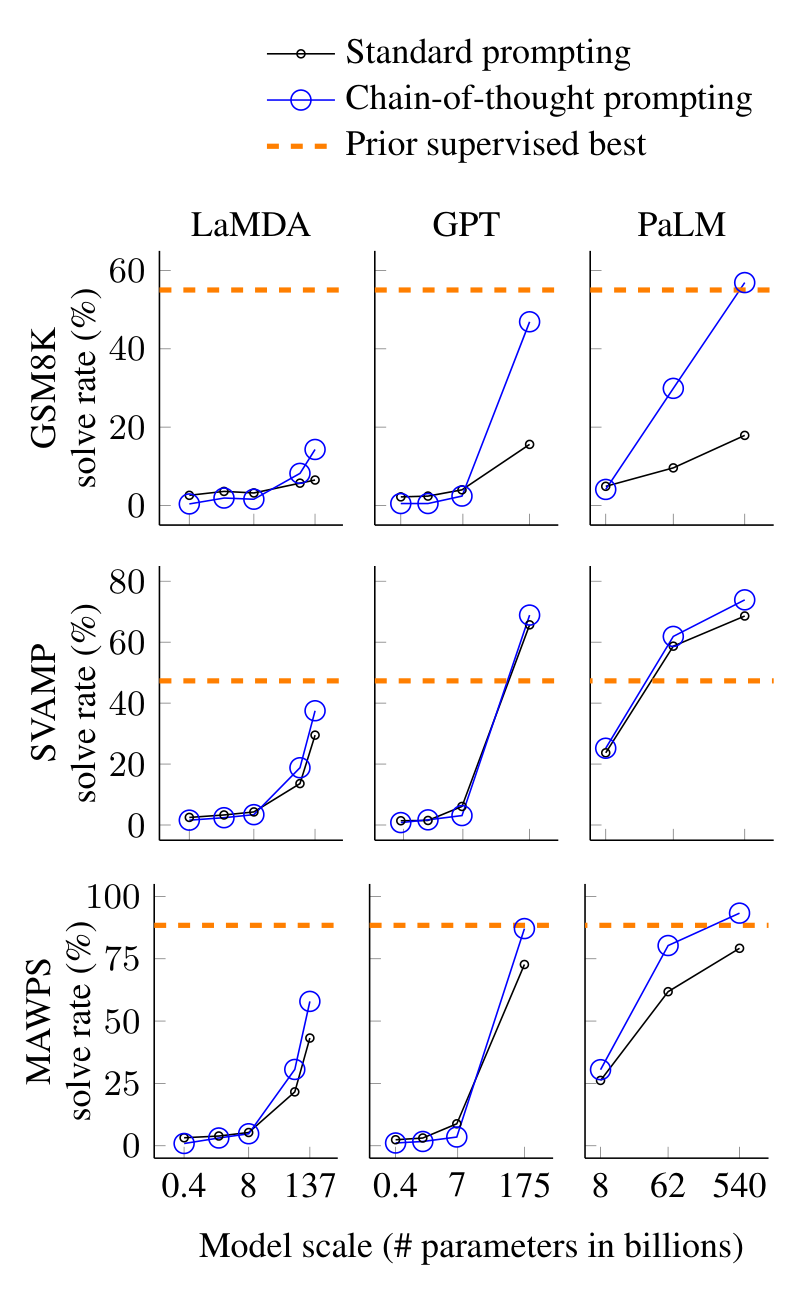
There are three key takeaways. First, shows that chain-of-thought prompting is an emergent ability of model scale (Wei et al., 2022b). That is, chain-of-thought prompting does not positively impact performance for small models, and only yields performance gains when used with models of ∼100B parameters.
핵심은 세 가지다. 첫째, 에서 보듯 chain-of-thought prompting은 모델 규모에 따른 emergent ability다(Wei et al., 2022b). 즉 chain-of-thought prompting은 작은 모델의 성능은 높이지 못하고, 약 100B 파라미터 규모의 모델에서만 성능 향상을 가져온다.